When I think of Dwarves, I don’t think about beards, ale, and smithing. I think about stone. The mountains they delve into the way they have a relationship with rock and the cavernous dwellings they call home. The earth’s greatest craftsmanship is after all mountains, so it only makes sense that its greatest craftspeople, dwarves, would live within them.
One historical sword shape that has always fascinated me is the executioner's sword. It was specifically designed for executions, with a broad blade sharpened for powerful chopping blows, and no point because it wasn't intended for thrusting. So there's something strangely honest about an executioner's sword. It isn't pretending to be versatile. It exists for one terrible purpose, and every aspect of its shape reflects that.
Sword design tells you a lot about what a weapon was built to do. It's also often a direct reflection of the materials available during a particular period. Bronze Age swords, for example, tended to be shorter because bronze becomes structurally weaker as blades grow longer.
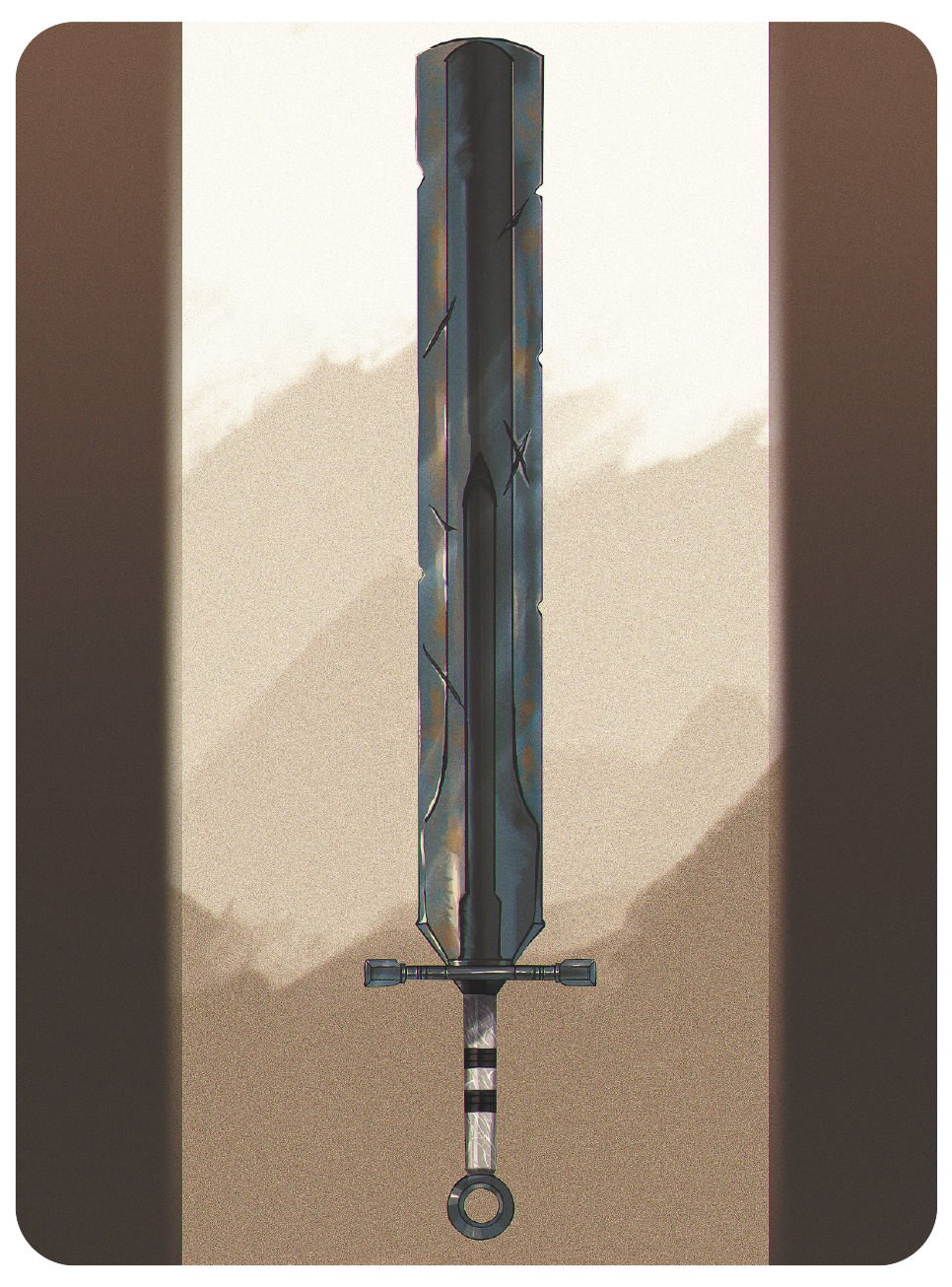
Stônbræker is a sword forged by dwarves to fight giants. I imagined dwarves wielding this broad, brutal blade to literally cut giants down to size. I also liked the practical idea that a sword without a point would be less likely to catch on cave walls during underground combat. A slash that misses is less likely to catch against a jagged piece of stone.
Beyond the practical considerations, I wanted this sword to feel physically imposing, with a silhouette that leaned heavily toward square shapes. Dwarves are the best little squares out there, after all. They are rigidly reliable, stubbornly stable, and purpose-built for life under the mountain.
A legend is unearthed by drums in the deep.
As thick as the stone skin that it can split, dwarves forged this hulking blade to tear down their ancient foes: Stôn Giants. Given the stout nature of its forgers and intended wielders, this blade is as light as a feather despite its blade’s width. Naturally, the blade is chipped here and there from a dull-headed dwarf attempting to mine with the thing.
It was sealed away in a vault deep within the Înk Mountain Mason’s vault, which was said to be uncrackable.
The thief who stole it admitted that the vault would undoubtedly be a challenge for a dwarf to pilfer.
Naturally, that thief was an Elf.